Event Details
Pyrolysis Oil Production from Waste Fuel to Oil Processing Plant Suranaree University of Technology
Pyrolysis Oil Production from Waste Fuel to Oil Processing Plant Suranaree University of Technology
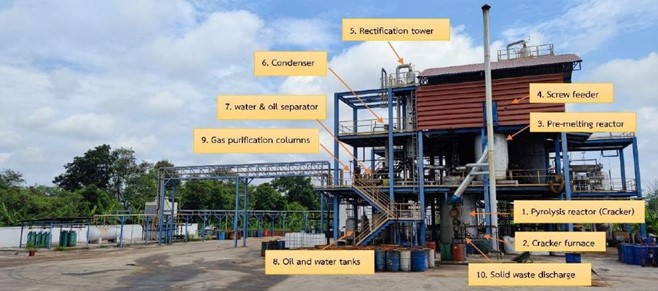
The pyrolysis oil production of the research will be tested using the waste to oil processing plant of Suranaree University of Technology, which is a prototype factory that is designed to handle 5 tons of plastic waste per day, equivalent to about 4,000 liters of fuel oil produced per day. Figure 1 shows an overview of a waste plastic to oil processing plant. Suranaree University of Technology The principle of operation of waste-to-oil processing technology By Pyrolysis Process (Pyrolysis Technology) Waste to Oil Processing Technology by Pyrolysis Process The system can accommodate 5 tons of plastic waste fuel per day and can produce about 4,000 liters of oil per day. The working principle is that the plastic waste raw materials are conveyed to a plastic melting machine (pre-melter at a rate of 100 - 250 kg per hour) to melt the plastic and be ready to vaporize when exposed to higher heat. After that, the liquid plastic flows into the reactor The Continuous Stirred Tank Reactor (CSTR) with a stirrer
works continuously to increase the heat transfer rate . When the plastic changes its state from liquid to vapor, it flows up to the distillation tower. The distillation tower is responsible for separating heavy and light molecule oil vapor. After that, the steam will enter the condenser. The condenser flows into the oil/water separator, where the water falls below the tank and the oil floats on top of the tank. When the resulting oil reaches a certain amount, it flows across to the hopper. The remaining gas that has not yet condensed will flow to another condenser. The remaining gas is natural gas and is used as fuel for further heating of the reactor. The resulting oil will be blended oil, with the main component being diesel fuel. (50-60%) Neptha (15-20%), fuel oil (5-10%), which can be refined again to produce oil that can be used in engines or machines. last The non-volatile part in the reactor will be released as carbon residue. (10-25%), which can be used to replace coal in industrial applications.